

Product Description
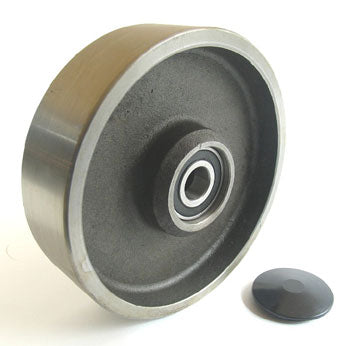
BT 102667-A is a steel steer wheel assembly with sealed bearings and open hub configuration, designed for BT manual pallet jack models L2000-U and L2300-U. Manufactured from SAE 1045 heat‑treated steel, this wheel features a zinc‑plated finish for corrosion resistance, and precision 6204 series ball bearings for long service life. The assembly is engineered for direct replacement and compatibility with and equivalent part numbers.
Compatibility: Fits pallet jacks made by BT, model L2000. SKU: BT 102667-A
Specifications
Material & Construction
| Wheel Material | SAE 1045 heat-treated high-carbon steel, machined finish |
| Bearing Specification | Precision deep groove ball bearing, 6204 series, sealed |
| Hardness | Rockwell C45 minimum |
| Finish | Zinc-plated for corrosion resistance |
Dimensions & Design
| Hub Configuration | Open hub |
Part Numbers & Compatibility
| Manufacturer Part Number | BT 102667-A |
| Compatible Equipment | BT manual pallet jack models L2000-U, L2300-U |
Performance Specifications
| Service Life Rating | Minimum 200,000 rolling cycles under rated load |
| Bearing Service Life | 24-48 months typical, depending on usage and environment |
Frequently Asked Questions
Q: What is the BT 102667-A steer wheel assembly used for?
A: The BT 102667-A is a replacement steer wheel assembly for BT manual pallet jacks. It provides directional control during pallet handling operations and is designed as a direct replacement for equivalent wheels on L2000-U and L2300-U series equipment.
Q: Which BT pallet jack models are compatible with the 0000-102667-A?
A: The BT 102667-A is compatible with BT manual pallet jack models L2000-U and L2300-U. Verify your exact model before ordering to ensure proper fitment. Check your equipment documentation or contact the manufacturer if you are uncertain of your model designation.
Q: What does SAE 1045 heat-treated steel provide in terms of durability?
A: SAE 1045 is a medium-carbon steel that is hardened through heat treatment to withstand repeated steering loads and lateral impacts without permanent deformation. This material specification is standard in heavy-duty material handling equipment and ensures reliable performance over the wheel assembly's service life.
Q: Why is the zinc-plated finish important on this wheel?
A: The zinc-plated finish protects the underlying SAE 1045 steel from rust and corrosion. In warehouses, loading docks, and outdoor environments where humidity, moisture, and salt exposure occur, this protective coating prevents oxidation and extends wheel assembly life. Periodically inspect the coating for any damage or exposed bare steel.
Q: What are the 6204 series sealed ball bearings, and how long do they last?
A: The 6204 series sealed ball bearings are precision deep-groove bearings common in material handling equipment. They are sealed to prevent debris and moisture ingress. Under typical warehouse usage, these bearings remain serviceable for 24 to 48 months. Replace the entire assembly if bearings become noisy, stiff, or develop play in steering action.
Q: What is an open hub configuration, and what are its benefits?
A: An open hub design allows visual inspection of the bearing and axle condition during routine maintenance. This configuration is typically lighter than closed hub alternatives and reduces manufacturing cost. Open hubs provide adequate protection in indoor warehouse environments and are commonly used on manual pallet jacks.
Q: How should this wheel assembly be maintained?
A: Maintain the wheel by periodically checking that steering action is smooth and responsive. Inspect the zinc-plated finish for damage or rust spots; address any corrosion early to prevent deterioration. If bearings become noisy or stiff, the entire assembly should be replaced. Store wheels indoors in a dry environment when not in use to prevent moisture damage.
Q: What is the service life expectancy of the BT 102667-A?
A: The BT 102667-A wheel assembly is rated for a minimum of 200,000 rolling cycles under rated load. Actual service life depends on usage intensity, load distribution, floor surface conditions, and maintenance. Wheels used in light-duty indoor warehouse applications typically last longer than wheels used in high-intensity or outdoor environments.

